Latest Posts

Internet Safety E-Lesson

It has become a responsibility of educators, parents, guardians, and our greater community to protect our children from the Internet. The world-wide web is a powerful tool with limitless potential. The challenge facing all of us is to lead by example and partake in safe Internet practices.

I follow a number of websites that I recommend to anyone studying the topic. Check out, Common Sense Media and CyberTip.ca to get started.

When tasked with the challenge to produce a constructivist e-lesson in ETEC 530, Constructivist Strategies for E-Learning, I decided to create a project based lesson targeting Grade 11 media art students, entitled “Don’t Be A Victim”.

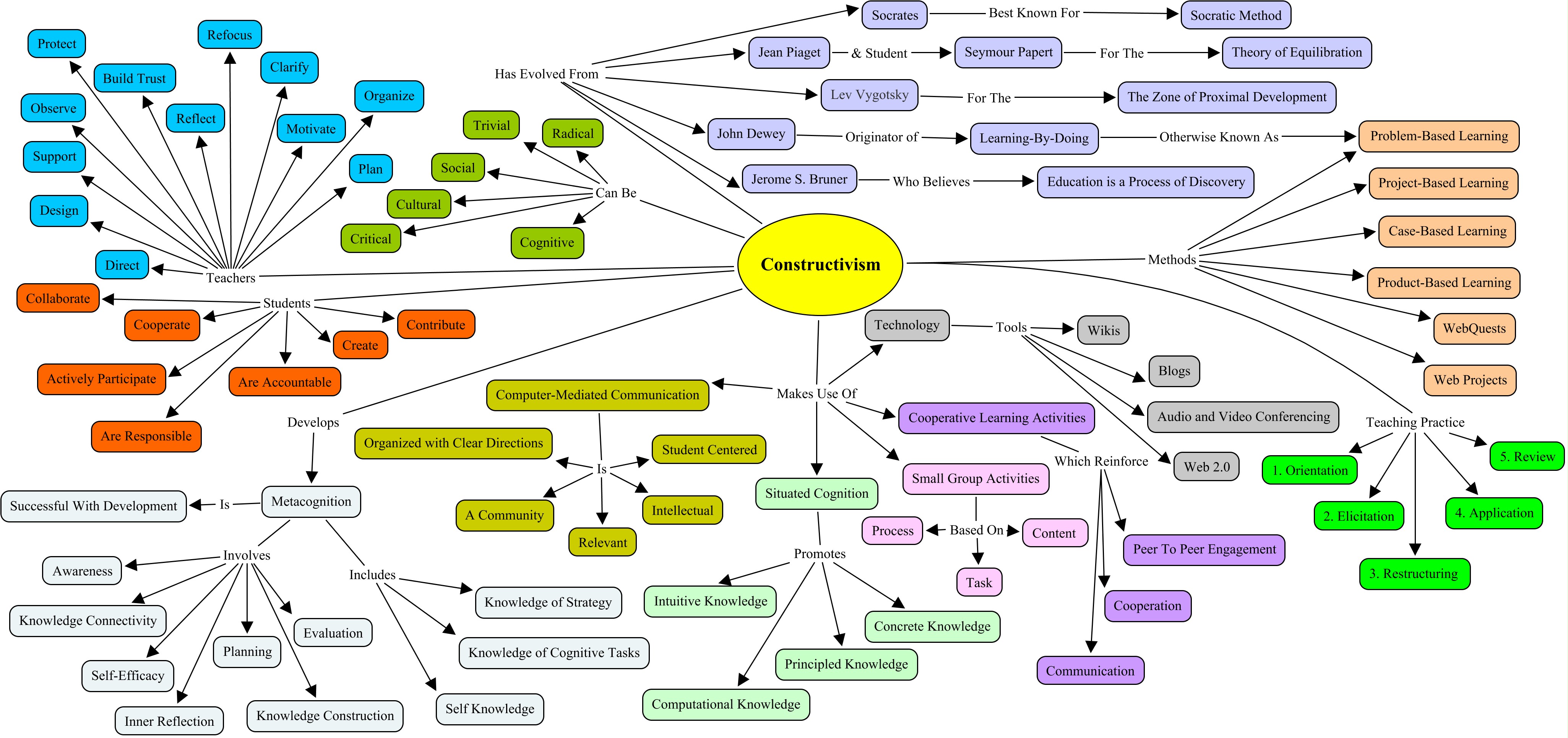
Constructivism is a learning theory which states that people construct their understanding based on experience and reflection. I believe that knowledge is constructed, and place value in constructivist learning strategies that are project, product, or problem based. I find these types of learning activities to be more meaningful for students. I have found that when the learning activity is personally relevant (as it often is in a constructivist lesson), and a student is genuinely interested, then the learning outcomes will inevitable improve.

You can click on the concept map that I produced using Cmap Software  that defines constructivism for me. To enlarge the image and to better familiarize yourself with the learning theory simply click on the icon below.
TAvenia_Constructivism_CMap

In the lesson, students create a web advertisements to protect young people from online predators and/or cyberbullying. The students work in teams to produce the advertisement and individually write a letter formally pitching their advertisement to the Internet Safety Coalition to review their understanding. Students are afforded the opportunity to reflect on the entire unit of study in a cumulative group activity. Please follow this link to visit the e-lesson, Don’t Be A Victim.

Don'tBeAVictim


References

Avenia, T. (2012). Constructivist concept map [Masters project]. The University of British Columbia, Vancouver, BC

Avenia, T. (2012). Don’t be a victim: A constructivist lesson in grade 11 media arts [website]. Retrieved from http://blogs.ubc.ca/surfsafe/

The Economics of Technology

I am one of three educators who created an online learning conference to introduce students to the concept of macro economics as it relates to technology. I’m very interested in economics as the social science has contributed to my decision making and is present in every action I take. Take the concept of opportunity cost as an example. Opportunity cost is the loss we incur when we choose one action over another. Time is an excellent example, as it will “cost” you time simply to read this post. An economist has to then ask himself or herself, is the value I gain from reading this post worth the loss in time. I hope so!

The attached online learning conference, The Economics of Educational Technology, will take you through a 7 day collaborative inquiry-based learning activity. You will learn key terms to further develop your understanding of macroeconomics. You can read two academic summarizations, “The Economics of Educational Technology” by Puryear, J.M. (1999, September), and “Some Simple Economics of Open Source” by Lerner, J. and Tirole, J. (2002), that I wrote.  You will also have the opportunity to participate in discussion forums and online activities to further your understanding.

Please click on the image below to visit the online learning conference,
The Economics of Educational Technology.

economics_card

I’m curious, do you consider the opportunity cost of every decision you make? Might you start? This is how economics creeps into everything we do. You may find yourself asking, what could I have been doing if not this, and what is the benefit as well as the loss that I will be subjected to for making this decision?

I hope you enjoyed learning a little more about the economics of technology. Moreover, I hope you find pleasure in weighing the pros and cons of your decisions and consider them as an economist would.


Reference

Avenia, T., Campbell, G.,  & Chen, J. (2012). The economics of educational technology [website]. Retrieved from https://etec511dlg9.wordpress.com/

Wiki Author

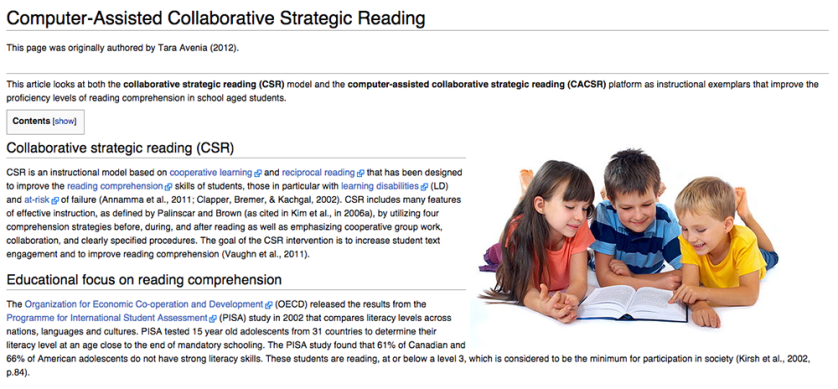
I published the wiki, Computer Assisted Collaborative Strategic Reading (CACSR), in 2012 as part of the course requirements in Design of Technology Supported Learning Environments, ETEC 510. I investigated two instructional platforms that attest to improve the proficiency levels of reading comprehension in school aged students. My research was followed with this publication, that targets educational professionals and fellow scholars. I concentrated my efforts to author this professional work in both a succinct and detailed way.

Please click on the card to read my report on the CACSR model.

CACSR


Reference

Avenia, T. (2012). Computer-Assisted Collaborative Strategic Reading [Wiki]. Retrieved March 1, 2015 from http://etec.ctlt.ubc.ca/510wiki/Computer-Assisted_Collaborative_Strategic _Reading

Research Review

Research Methodology in Education, ETEC 500, was one of the first courses that I completed in my Masters. It was here that I learned how to review educational research, and also how to plan and execute an action research study. I am extremely thankful that I completed ETEC 500 early in my Master education. ETEC 500 gave me the knowledge and the confidence to critically assess, plan, and execute research.

In ETEC 511, Foundations of Educational Technology, I produced a report titled, Socioeconomic Factors, the Use of Technology in Teaching and Learning, and the Impact on Achievement: A Critical Review of the Research. This experience taught me that educational technology has the power to bridge socioeconomic gaps and the gender divide. This is also the paper that first sparked my interest in the factors of educational technology that affect academic achievement.

You can read Socioeconomic Factors, the Use of Technology in Teaching and Learning, and the Impact on Achievement: A Critical Review of the Research in its entirety directly on this blog. The literature review has summarized and critiqued seven research articles, beginning with pre-school aged students and moving throughout the ages to secondary school graduates, and focuses on the socio-economics of educational technology. The synthesis will point out that ICT has the tremendous power to transform education and to improve academic achievement. Students from various socio-economic backgrounds can benefit from ICT integration, but as the synthesis suggests only if the technology is integrated carefully and if the use of ICT is prioritized.


Reference

Avenia, T. (2012). Socioeconomic factors, the use of technology in teaching and learning, and the impact on achievement: A critical review of the research (Unpublished masters report). The University of British Columbia, Vancouver, BC

Welcome To My Portfolio

Thank you for joining me online. I have designed these pages in the hopes of demonstrating my belief that educational technology represents the pedagogy of the future. I think of these pages as a window into my accomplishments as a technological educator and a display of my teaching philosophy. I believe strongly in the value of 21st-century education, and feel it should include the use of technology to facilitate the development of transferable skills. Such skills as, critical thinking, problem solving, confidence, and the ability to communicate as well as collaborate.

My ePortfolio includes the most recent posts in the top most order. Every blog post added to my ePortfolio has been categorized and tagged, you can browse a category of your liking or scroll through the entire collection if you prefer. Here you will find examples of my work and lessons that include webquests, podcasts, video tutorials, word-art, animated timelines, research publications, concept maps, and so much more.


Reference Note:

Please note that every featured image in this ePortfolio has been downloaded from Pixabay and Shutterstock. All images are royalty free, and free for commercial use with no attribution required.